Oh the Humanities!

There’s an old quote, I think from Megan McArdle, that media criticism dominates blogging, and the reason is because it’s easy.

I am about to indulge in some media criticism. Forgive me; my only defense is that the medium being criticized is almost philosophy, and criticism of philosophy is almost philosophy itself, so this is almost almost philosophy, and that’s better than a lot of things.

To set the stage: Tyler Cowen is a professional blogger who has a side hustle as a tenured economist. He has a podcast, Conversations with Tyler, that gathers as its guests more first-rank academics, artists, businessmen, athletes and policy figures than almost anything else of any kind – Peter Thiel, Paul Krugman, Kareem Abdul Jabbar, Paul Romer, Malcolm Gladwell, Margaret Atwood, Daniel Kahneman, Camille Paglia, Kwame Anthony Appiah, Niall Ferguson, David Deutsch, Rebeka Kukla, John Brennan, Jimmy Wales, Adam Tooze, Agnes Callard, Cass Sunstein, Slavoj, Esther Duflo, Mark Zuckerberg, Acemoglu, Masha Gessen, Steven Pinker, Nate Silver, Hal Varian, Jordan Peterson, Nassim Taleb, Larry Summers, even Danticat and Knausgaard,  Annie Duke, Garry Fucking Kasparov.

I think perhaps no one else since Athens has had long conversations with that many fascinating and even historic figures across that wide a range of excellences. Except Terry Gross.

Given the guests, it always surprises me by not being better than it is, and the reason is usually because the guests won’t answer Tyler’s questions.

But today this became egregious. The guest was Amia Srinivasan, likely the biggest name under 40 in Philosophy and certainly the one with the most popular press (Kate Manne might get more, but Kate Manne sucks and everyone in philosophy agrees. In contrast, Amia Srinivasan is taken very seriously and personally liked by most people in the profession). I haven’t read her work, which is mostly on the genetic fallacy and on sex, but people I respect have read her and found her insightful and sane.

Alright now I’ve built up a mystery long enough. I’ll show you some transcript.

COWEN: As you know, disabled individuals in the Netherlands often receive a sex voucher to transact with sex workers. Is this a good idea or a bad idea?…

COWEN: It seems there’s a simple David Braybrooke-like basic-needs argument that disabled individuals in the Netherlands — there’s something very good we could do for them that also lowers the stigma from them having this kind of fulfillment or enjoyment. Then to cite this big external ideological debate and say, “Well, we’re not going to do this for you because we don’t like its symbolism in some other set of debates that we think are more important for you” — that strikes me as wrong.

SRINIVASAN: Tyler, let me ask you this: Why are you interested in the question of disabled men having state subsidies?

COWEN: I said disabled individuals, right?

SRINIVASAN: No, you just said disabled men.

COWEN: Okay, that’s what most of it has been.

SRINIVASAN: Right. Why is that?

COWEN: In my view, men and women are intrinsically different for biological reasons, including in their attitudes towards sex, and more disabled men are interested in taking up that offer than are disabled women.

SRINIVASAN: What are the biological drivers of these intrinsic differences between male and female attitudes towards sex, in your view?

COWEN: Probably, ultimately, Darwinian — the fact that there’s a different investment in child creating and child raising with men than with women, so we’ve evolved to be somewhat different.

SRINIVASAN: You think for men sex is a basic need, but for women it’s not?

COWEN: No, that’s not my view at all. I’m not always sure what “basic need” means, but I certainly think if there’s a voucher system, it should be available to men, women, other genders — however one wishes to talk about it, and not just men.

SRINIVASAN: Let me just say, you were asking — when we’re thinking about this policy question — why should we bring in a whole, completely orthogonal ideological question?… I think I will just get off at the very start, when you’re just thinking sex is this basic need for men. I think that, if we’re talking about pernicious ideology, that is very much a piece of a pernicious patriarchal ideology that thinks that, for men, sex is this basic good. It’s like food or water. The women who refuse to have sex with men are depriving them of a basic necessity. Women are both that necessity and the gatekeepers of it.

This is very hostile environment for Tyler. But more importantly, this is a bad way to have a discussion. If some Sexist Strawman Tyler had said, “Don’t you think that men have special rights to have sex with women, because women deserve to be subservient, men just need sex, and sexual coercion isn’t really that bad?” then Srinivasan’s response would be appropriate.

But it’s obvious that’s not what Tyler was saying. Beyond that, it’s not even an interesting position to argue against. It’s not something Tyler could possibly have said, because, frankly, no educated person you meet in real life would say that. And it’s not as if Srinivasan is advancing novel arguments. Her arguments are so sound, and so utterly conventional, that they are surely the reasons that Tyler (or you, or I) doesn’t adopt Sexist Strawman Tyler’s views in the first place.

That’s what makes Srinivasan’s talk bad discursive practice. It’s neither relevant to Tyler’s point nor an interesting aside. It has no elucidatory purpose whatsoever. But Srinivasan is very smart, so the only explanation is that she was trying to do something other than elucidate. But whatever she was doing wasn’t nice either. She wasn’t trying to be humorous or affable. From the text alone, it’s possible she was just letting off steam. The audio makes it clearer that that’s not the case, and she is in fact aggressing. She is making a threat that Tyler needs to back off from the topic, and, cleverly, she’s doing that with enough plausible deniability that you’d have to write a whole blog post to catch her on it.

I don’t want to obsess too much over the details of this, I just found it a particularly striking example because Amia Srinivasan isn’t some clown from Twitter, she is the doyenne of Millenial philosophy.

But the example makes a few things stand out:

  1. No academic would ever speak to a student or colleague this way about any topic other than race or sex. I’ve never seen such a thing. Academics do not generally try to scare students away from inquiry.
  2. If an academic did talk to a student or colleague this way on a less charged topic, other academics would be shocked and horrified.
  3. This is a perfectly normal thing to happen in the academic study of race and sex.

These special race-and-sex norms aren’t good norms for discovering truths about the world. In academia, as in private enterprises of discovery like economic consulting and pharmaceutical research, a community of (more or less) equals argue more or less the same way academics do. The private communities operating under market constraints have the same charitable-discussion norms that academia does. Where the goal is learning, the discourse norms are never censorious.

So the philosophy of race and sex is uniquely unhealthy. Okay, is that shocking?. Often, subfields or entire fields can be nearly devoid of intellectual value

What’s remarkable isn’t that the academic study of race and sex has bad discursive norms, but that the academic study of race and sex is increasingly the entirety of the humanities. Philosophies of Race and Sex and leftish political philosophy are rapidly growing as a proportion of new hires, and applied/social philosophy is decreasingly the world of Rawls and increasingly the world of Mills [actually, worse disciples of Mills, who was charitable, kind, and committed to persuasion!].

Now, if we adopt the old science-fictionalist’s habit of extrapolating trends and calling it the future, we might get very afraid that bad discursive norms could conquer the world.

But that’s not happening; it’s an illusion. They won’t. There are bad speech norms typical of the academic study of race/sex: the suspicion, groupthink, uncharitability, obvious politically motivated reasoning. Yes, these have taken over much of the humanities. But they have clear limits. Perhaps the failures of the limits are what makes the growth so scary. After all, it’s puzzling how they could conquer anything at all, when these speech norms are so unattractive, and the justifications for them incoherent. Since the argument offered for them is their necessity for fighting patriarchal and white supremacist powers, they become increasingly quixotic as intersectional theory becomes formidable, and even hegemonic, within the academy. Everyone sees through the ruse, so how does the conquest continue? I admit that is a puzzle, and a scary one – why are the walls breaching? How could something so apparently weak have conquered so much?

The answer to the puzzle is that they haven’t actually conquered anything at all. 

I know, that sounds dumb, but bear with me. What makes it possible for “wokeness” to seem an all-conquering colossus while really being quite weak is the total collapse of the humanities in general. As LSE Philosopher Liam Bright (Twitter’s @lastpositivist) put it:

What I think is clear though is that in general there has been a rout of high culture, that this rout has left much of the humanities without its corresponding social or cultural role, and even where we have found institutional niches we still have not regained purpose.

The thing is, intersectional theory and the Cult of Bad Discourse Norms hasn’t actually grown much in importance in the last 40 years. No one in the Bad Speech Norms culture looms any larger today than Andrea Dworkin did in the 70s. What’s happened is that the rest of discourse has withered away. Even though the share of tenure track spots in philosophy that go to feminist/race philosophy has gone from negligible to perhaps as high as 20%, there are still only about 8 per year. That’s much lower than in 1975 or 1980.

The Woke “Monster” isn’t some titan, conquering the world of letters. It’s just the last man standing. As Bright writes again (this time as blogspot’s sootyempiric), describing the growth of value theory, political theory, and intersectional analysis within Philosophy:

… rather than there being a widespread belief that there is a natural and desirable political upshot to the sort of work one might do in analytic philosophy, instead there is a belief that only by making such links to applied issues can analytic philosophy justify itself… My sense is that now what we see is a desperate scramble to show that the skills or tools we have might find some problem space wherein their, our, worth can be made manifest. As mentioned above, even though this has been where I have done my own work (and maybe all this is just me projecting my insecurities outwards!), I do not think such a problem space has been forthcoming.

The actual humanities died because they are anachronism. No one believed in the projects, so why should the norms that sustained those projects survive? What filled the gap was a sort of institutionalized activism, to the extent that anything filled the gap at all. Their poor discourse norms shouldn’t surprise us. Poor discourse is a distraction from actual inquiry, so it can only take over when no one really cares about the inquiry in the first place and everyone is content to let the distraction play itself out. Since academia has always leaned left, we shouldn’t be shocked that what takes advantage of the crisis of confidence of the Liberal Arts is a leftist moral crusade, rather than, say, anti-abortionism or Bushist foreign policy.

It’s the same in journalism. In 1995, if you wanted to pay a Columbia graduate $25,000 a year to work for a publication no one back home ever read, then you had to let them spend the day scribbling out their furious and probably leftist pensees. The same is true today. It’s just that now that’s all of journalism that’s left.

Now, there are more things that go under the heading of “woke” than the Bad Discursive Practices I’ve been describing. It’s true that youth cohorts are quite leftist and such a wide generation gap is new. I have some theories about that. But I think the Poor Discourse Norms are actually a separate phenomenon. It’s true that young people are not as bullish on civil liberties as they used to be. It’s also true that classically liberal organizations have moved comically leftward as education polarization has kicked into high gear. But the “Wokeness” that people are scared of, with the speech policing and the anti-science attitudes and the actual literal iconoclasm, remains confined to institutions that are in economic and spiritual free-fall.

Nothing that was previously healthy has been taken over by the scary kind of woke, nor any other kind of bad leftism. Not even the Democratic party. Despite a congressional office’s demographic similarities with a newsroom, what keeps these offices mission focused is that they have a purpose, and believe in it, and will fight distractions and disruptions to keep the objective in sights.

Philosophy, History, and Literary Theory do not have any objectives. Means can only outlast their ends so much.

Our former aphorist in chief is incorrect. Wokeness isn’t going to kill the humanities. Wokeness is its corpse.
How Far can Bentham Carry us?

What is the good life? From that, what is the right way to live?

One might propose that both of those questions have more or less the same answer. That is: the good life is having something we are going to call “happiness” and the right way to live is to cause the most happiness for the most people (or, in modern interpretations, the most living animals).

Intuitive and plausible. And yet, there is a fashion among ethicists not to be utilitarians that goes back centuries. Professional ethicists, except for a few pop-stars like Peter Singer and Derek Parfit, tend to belong to more obscure and esoteric ideologies, usually deontological ones (that is, which actions are ethical turns on ethical laws over actions themselves are right or wrong, not their consequences). The position de rigeur at the moment is probably that of the care ethicists, but in the longue duree care ethics is just one more wave bashing against the rocks of That Old Bitch Kant. There have been centuries of such waves, and more will come in later years, but the rocks will abide.

I think the two main reasons that few ethicists are utilitarians are that:

  1. Everything interesting to say on the subject has already been said.
  2. If utilitarianism is true, then a philosopher’s training is not very useful for answering ethical questions.

I am not, myself, a deontologist. My main opposition to the idea is that, usually, if we want to think through whether a deontological position works or not, we think about whether the consequences of people following that position would be good. Kind of defeats the purpose. My second is that I think that the whole point of actions is that they cause effects in the world. If the whole point of actions is that they cause effects, the effects might as well be what we grade them by. My third is that each action can be classed in a number of ways, and it’s hard to not have the classifications affect which laws apply to which actions, yet we probably don’t think that different classifications of our actions should lead to different moral laws. Some care ethicists actually have neat solutions to this last problem, and a few have neat answers to the second. In the end, there are many deontologies that are internally consistent, and many of them match a number of our ethical intuitions, but they do not sway me personally. So from now on we’re going to talk a utilitarian line.

I want to launch an alternative critique of utilitarianism, which is that, even taking utilitarianism for granted, it’s very unlikely for utilitarian arguments to answer all of life’s ethical questions, because it would require happiness to have a very unlikely mathematical form.

Pretend we have a fantastic understanding of the brain, and such reliable reporting on satisfaction, that we are able to totally rank how happy any individual is under any given condition. 

In all plausibility, such a ranking is impossible, because there are multiple kinds of happiness that can’t be perfectly compared. There is satisfaction, and excitement, and love, and wonder, and pride, and awe. Granted, these may all just be different triggers to release dopamine. But the brain is complex, and not everyone loves heroin. Happiness is not a chemically simple phenomenon, so it is probably not morally simple either. Happiness involves a balance of different factors which are difficult to directly compare. 

However, it’s possible these aren’t so incomparable as they seem. After all, we compare them against each other every time we make a decision. Our decisions are affected by considerations other than our estimates of how happy they would make us, but it’s possible that, with all the science done, you can measure and grade all the many happinesses, ironing out beliefs about effects, expectations of future consequences, considerations of others, and all our pathologies of pride, guilt, and shame. Of course, it’s also possible that you’d pull away the cloth and see that by that point happiness itself would by then have been ironed away as well. Eh.

Multiple happinesses wouldn’t make utilitarianism useless. There will still be lots of questions utilitarian analysis can answer, because there are lots of situations in which one is less happy in every single way, such as physical torment, or when guilt and grief sour all joys. But if there were multiple happinesses, utilitarian analysis wouldn’t be able to help judge happinesses against each other.

However, that’s an old critique, and not the most interesting. Again, we constantly make decisions trading one happiness against another. So instead, suppose that the total-happiness-ranking is theoretically possible. Suppose that through neuroscientific genius, we have composed a happiness index that can measure the joy in any given soul, from the socialite to the scientist to the centipede, and spit out a number ranking how happy they are.

In such a case, we might have a perfect understanding of The Good Life, and yet still not have the answers to most ethical questions. And the reason is because a ranking is not enough.

What we would want, to have a solid utilitarian answer to all ethical questions, is a ranking of the happiness, not only of humans, but of groups.

And, to get a ranking of the happiness of groups, then happiness would have to not only have an ordering, but ratios. We would need to be able to say not only that one person was happier than another, but that they were twice or three times as happy. And not only would we need to be able to say this, we would need to be able to say it in a unique special way that’s true, as opposed to all the other ways that are false.

Why? Well, as a good utilitarian,  I will often want to say that a decision is a wrong one, even if it makes someone happier. That will be because it makes someone else sad, and because we think the sadness outweighs the happiness. For these comparisons to be well-defined, we will need ratios of happiness, not just a ranking, at least most of the time..


Not always! Suppose I am a jolly, carefree creature, and my brother a melancholy and wretched sort. One day my brother, simply for pleasure, shoots me in the back. This produces in him a mere fleeting moment of joy, in which he is not even as happy as I had been. In turn, I am left crippled and miserable, even sadder than he was before his savage escapade.

In such a situation, we could say that an action was wrong even though it made one person happy and another sad, only using a ranking of happinesses, because the action raised my brother in the ranking less than it lowered myself. But the very contrivance of the situation demonstrates how rarely a simple ranking of happinesses will tell us whether an action is right to do.

Much more often, the morality of an action will be unclear. Suppose I love to be loud in restaurants. Just scream. Screeeeeeeeaaaaaaam. If I were instead tactfully quiet, I would be sadder than anyone else in the restaurant, and at full volume I am as happy as anyone in a restaurant can be. However, my sadness ruins the evening for many other customers, though they never become as sad as I would be if forced to be quiet.

Should I pipe down? Unless we can define happiness ratios, the answer is unclear. Yes, I have moved farther up the ranking than anyone else has fallen. Yet, I have lowered more people than have been raised (let’s say, fifty). Since I can’t say that my squeals and squaks raised my happiness fifty times as much as the happiness of each other diner was lowered, I can’t say whether the action was immoral or not.

And the issue isn’t just about comparing disparate losses to concentrated benefits.

Suppose your dying grandfather’s only wish is that you spend a day with him recording his stories and opinions. You’ve heard his stories and opinions before, so spending a whole day listening to them is kind of a bummer. Even though it brings your grandfather great joy to have his final wish fulfilled, he is not made quite as happy as you would have been if you hadn’t had to have this bummer of a day. Even with you listening to him, he’s still dying, after all. However, you are not made nearly as sad from your bummer of a day as he would be about dying unfulfilled and alone.


Even in this case, where the morality seems intuitively clear, a purely ranking-based utilitarian analysis cannot answer whether helping your grandfather is the right thing to do. Because your drop in rank is not totally contained by his rise in rank (a dying man, no matter how fulfilled, is not as happy as a carefree twentysomething) we can’t say whether his gain was greater than your loss.

To be able to say that, we would need to have ratios of happiness. In other words, happiness would have to be cardinal, rather than ordinal. If we could say that your grandfather would go from 1/10 as happy as your carefree self to 9/10 as happy, while you only lost 15% of your happiness, then we could confidently assert that helping your grandfather is the right thing to do.

But to have uniquely determined ratios of happiness would be extremely odd.

This is not how much of nature works. In science, the way we treat a phenomenon as “real” and “understood” is that we have fit it into equations. Force = Mass * Acceleration. Mass and Acceleration are fairly easy to measure, so we can measure forces by proxy, and then we can use force in all kinds of useful equations. This is why we say that force, as a phenomenon, is real and more or less understood.

But instead of talking about force, I could talk about shmorce, where shmorce is simply the cube root of force. I could then take all of my equations regarding force and substitute (shmorce3) where force was previously. All the math would be the same.

What we would need, to say that happiness has ratios, is to have a set of empirically verified equations where something like force clearly represents happiness and something like shmorce clearly does not.

But, this is frankly implausible. In all likelihood, it is not only impossible to determine which of many different indices should represent happiness in our equations, but there is no answer to the question of which index is correct

It would be very surprising if there were a way to correctly say that X is twice as happy as Y, rather than three or four times. Of course, a person might be willing to give up two hours of one happiness for one hour of another, but not three hours or four. But that’s just their decision about what they would prefer. A person only really knows one happiness at any given time (their current happiness) so we haven’t any reason to think that people’s preferences reveal anything fundamental about what happiness is, deep down. The same problem applies to how much money you would spend on something. Perhaps we can say, “Larry would be willing to spend ten dollars on having the karaoke room to himself, while Curly and Moe would each only pay $4 to share it”. But we cannot say, “Larry would pay $10 to be one person getting the karaoke room and another person not getting it, while he would only pay $4 apiece to be two people sharing it”. Perhaps money, like time, cannot measure happiness, because it has diminishing marginal returns.

But if we can’t use money to measure happiness, and we can’t use time, then money has diminishing marginal returns relative to what? Will we ever have an answer? And how will we know that answer uniquely right?

I think the fundamental truth is more likely that utilitarian analysis can answer some ethical questions, and solve some ethical dilemmas, but on other issues it simply does not speak – because happiness likely does not have the right mathematical form for it to tell us any more.

For the remaining questions, we are left to other ethical concerns: fairness, desert, equitability, perhaps piety or kindness. Happiness is only so important. There is more to the moral life.

How the Woke were Awoken

[Edit: Looking back on this, I think I undersell the role of the internet in fostering distrustful and anti-institutional politics. It has such a tendency to pull back hoods, and outrage is the handmaiden of virality. So, take the below as a hypothesis for why one distrustful politic emerged where it did, not a general theory of ideology in the last decade.]

Alright, everybody’s woke now. Twitter has been almost entirely consumed by Wes Yang types deriding this shift in cultural attitudes and Jamelle Bouie types deriding the Was Yangs for tiresome pearl-clutching over shenanigans at Cal.

I personally think the political stakes of wokeness are overblown. After all, Eric Adams is winning the race for mayor in *New York’s* Democratic primary. But, like similar shifts in the 1960s, the effects of wokeness will primarily be cultural. Already, I don’t think a show like Family Guy could come on the air these days, and it is remarkable the number of television programs about 19th century Britain that simply ignore its social and demographic realities. 

But why has this happened? Wokeness has as many explanations as it has enemies, but today I am going to advance a very simple one: Educated urbanites have all gone woke, and they are the only people who have gone woke, because the social worlds they live in really are the race-segregated capitalist nightmares that wokists tend to think the world to be.

The mystery is not “why are there wokists?”. Every country has a left. The mystery is, “why are all leftists race obsessed Yale graduates?”.

While no definition of wokeness is going to satisfy everyone, it involves the following features:

  1. A general assumption that any conflict is zero-sum. This involves:
    1. A belief that advantages are unearned.
    2. A distrust of markets.
    3. A distrust of all power-hierarchies, including the power of government enforcers.
    4. An assumption that all gains from any political or technological innovations will flow to the wealthy.
    5. A general tendency to overestimate the magnitudes of social or economic inequalities. 
    6. A distrust of formal liberties, such as free speech and freedom of association.
  2. An obsession with race, not as a sociological phenomenon, but only as a vector of oppression. 
  3. A tendency to view cultural products and social situations through a political lens.
  4. Highly affected language and word-choice, with liberal use of the letter x, or, increasingly, the @ symbol.

People find it mysterious why all 22 year-olds coming out of selective colleges view the world this way, especially since we’re the big winners from any oppression America might have.

It probably matters that the woke worldview is an extremely accurate description of selective colleges.

First, any given good college has quite absurdly high income inequality, far higher than any major country except South Africa. Part of this is, paradoxically, a result of range restriction. Almost everyone at a good college is from the top 20% of household incomes. At Harvard, Yale, and Princeton, as recently as we have good data, it’s around 70%. Normally, restricting the range of incoming incomes would lower inequality, but the top 20% of US incomes is where all of the real inequality-action is. So, because colleges take only upper-middle to upper class students, income gaps are magnified.

But that’s not all. Top colleges aren’t just more likely to have higher income students; they have a staggering number of stupendously wealthy students.

Across the ivies, typically 3% to 4% of students come from families in the top thousandth of household income. That means they’re about 30 times as well represented at top colleges than in the population overall. That dwarfs the roughly three-fold over-representation of the top income quintile. To make this kind of money, a household needs an income of more than $3.1 million. 

School% from top Thousandth of Income (above ~$3,140,000 as of 2019)% from top Hundredth of Income (above $630,000 as of 2015)
Brown4.3%19%
Columbia2.9%15%
Cornell1.5%10%
Dartmouth4.5%21%
Harvard3.0%15%
Penn3.6%19%
Princeton3.1%17%
Yale3.7%19%
Stanford3.5%17%

Cornell is notably lower than the others, likely because of its large engineering school and publicly supported colleges. 

The median household income at these colleges was only about $180,000 in 2015. Adjust some things to today-dollars and the 97th percentile person at one of these colleges (or even the 96th) has an income around 15 times the income of the median. At Columbia, Harvard, and Stanford, the gap is even more extreme.

SchoolMedian Household Income in 2015 dollars.
Brown$204,200
Columbia$150,900
Cornell$151,600
Dartmouth$200,400
Harvard$168,800
Penn$195,500
Princeton$186,100
Yale$192,600
Stanford$167,500

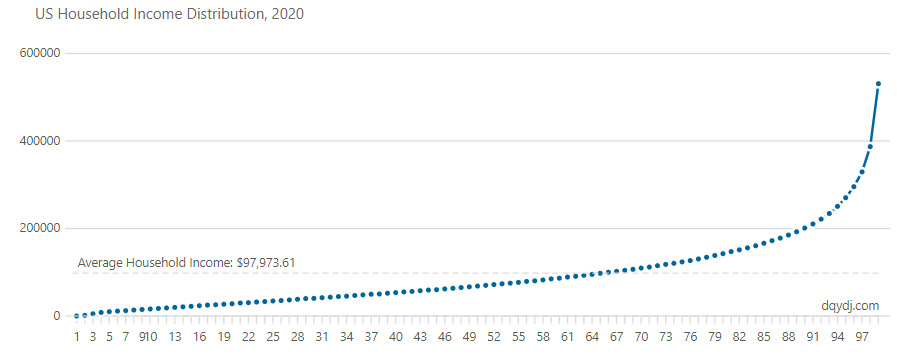
America overall is not nearly that unequal. The median American household has an income of $68,400. The 97th percentile is $329,352. That’s a factor of less than 5 between the two percentiles, compared to 15 at the best colleges.

And the difference between America and good colleges is actually even starker than that. Many differences in household income across America actually reflect age, because people make much more in their 40s and 50s than their 20s or 70s. If you look at individual incomes for 50 year olds (typically the people sending their kids to college), the median is $58,000 and the 97th percentile is only $235,000, only a fourfold difference. Parents of college students are mostly about the same age, so seeing the income gaps that we do is remarkable.

You see the same high inequality at colleges by comparing the median to the top 1% instead of the top .1%. At the typical Ivy in 2013, around 17-18% of students came from families making more than $630,000 a year, which means the 82nd-83rd percentile makes about 3.5 times the median. But in the US overall, the 83rd percentile of income only makes a little more than twice the median. To reach a household making 3.5 times the median, you have to get all the way to the 94th percentile. 

So income inequality at good colleges is very high.

Superstar-metros (where the woke graduates go after college) also have staggering inequality. Boston, New York, and the Bay Area are all in the top 3% most unequal metro areas by reasonable measures. Similarly, DC Has a gini-coefficient of around .51, while the US overall has one of only .48.

The inequalities in big cities are even less normal than they might appear. Normally, if you take a selected subgroup from a larger group, inequalities within the subgroup should be smaller than overall because the little group is selected, so they’re probably similar to each other. Take states. If you look at any given state, it will usually have lower inequality than the country overall. Out of America’s 51 jurisdictions, only 5 have Gini coefficients higher than the country overall, because people in a state tend to have similar incomes to other people in the same state. 

But the urban and educated states are special. Four of those five unequal jurisdictions are New York, Connecticut, California, and DC. New Jersey, Massachusetts, and Illinois are all in the top 15.

This is important. What’s distinctive about educated urbanites is not just that they live in somewhat more unequal societies than most Americans, it’s that they see wildly more inequality. For a hyper-educated American, the closer you look, the more inequality you see. For a normal American, it’s the opposite. 

Imagine some guy in a town in Wisconsin. First, you look at America. Some inequality. Then zoom in to the state. Okay. Wisconsin doesn’t have Greenwich, and it doesn’t have New Orleans, so there’s not that much wealth and not that much really deep poverty. A little more equal than the US overall. Okay, now zoom in on a town. Some towns have more rich people (maybe they have an engineering firm), and some have more poor (maybe they do chicken-processing), so the single town probably is even less unequal than the state. Now zoom to the single neighborhood. Well, houses in each neighborhood tend to have similar prices, so neighbors are even closer in income than fellow townspeople. Most Americans, in their daily lives, don’t see a huge amount of inequality. They mostly see people similar to themselves. 

But it’s a very different picture with the educated urbanite. The closer and closer you zoom, getting all the way to the circle of people walked-past every day or scrolled-past on Facebook, it just gets more and more unequal. 

And the inequality that the urbanite sees is especially racialized. It is remarkable how few poor white urban neighborhoods America has. There’s basically just Southie, which is already gentrifying. Instead, America’s poor whites are concentrated in rural and ex-urban areas.

What that means is that within expensive urban areas, racial inequality is severe. In the country overall, the median white household has an income about 50% higher than the median black household. But, in New York City, the median white household income is almost twice as high as the median black one. And that’s despite New York encompassing middle-income white neighborhoods far from city center that would typically be a different municipality (Staten Island and South Brooklyn). If you look at the more restricted San Francisco, the median white household has more than 250% of the income of the median black one.

The same thing happens in elite colleges. Colleges actively select for the richest white students and the poorest black ones, given the same standardized test scores. Combine that with the fact that many elite colleges draw heavily from incomes where there are essentially no black households, and you get an extremely high race-based income gap.

And these wealth gaps are unearned. The students coming to Harvard are all similarly capable. Sure, there are perks that help you get in, but the staggering inequality of resources is paired with a carefully maintained parity of ability. 

This means that the wealthy students are no more capable, or insightful, or hardworking than the poorer ones. But they are whiter.

So if you are a normal observant human looking around you, and you grew up in Westchester, Marin, or Brookline and then went to Duke or Hamilton, you might conclude three things:

  1. America is plutocratically unequal.
  2. This inequality is entirely unrelated to drive and skill.
  3. All poor people are black and all rich people are white.

So you’re going to end up a race obsessed socialist

Plus, in these societies, life really is zero-sum. Colleges only have so many spots and a heavily-zoned city cannot build new units. Furthermore, there is no such thing as real technological improvement in these societies. The value of the college is almost entirely the other people there, not anything about the college as an institution, and that’s basically true of cities as well. If technology improves the city/college, that just makes it harder/more expensive to get in. So the first 18 years of your life are a rat-race to win a zero-sum game, followed by another 10 years trying to win another.

I think this more or less explains why young educated urbanites are so much more woke than everyone else.

And the fact that it’s young, educated urbanites who are woke explains most of wokeness’s other weird features.

In short, why are the wokes… Annoying? Why do they inject politics into everything, and why are the politics so aesthetically obsessed? Why are movie reviews are useless now?

Rivers of ink have been spilled over this, but the most plausible answer is that Oberlin students have always been annoying about everything.

The strange, affected language? The constant one-upping and status games? The holier-than-thou attitude?

Have you ever listened to college radio?

There’s a special dynamic to academic political disputes that has an almost exact parallel in music. Once we understand this dynamic, nothing about wokeness is weird.

Like in music, as a participant in politics chats, your goal isn’t to come to correct opinions, it’s to look cool and smart and knowledgeable.

There are two ways to look cool and smart and knowledgeable:

  1. Actually know more than other people on topics of general interest.
  2. Focus on ideas and vocabulary that are so obscure that your interlocutors have never heard of them and haven’t had the chance to develop coherent objections.

Needless to say, the second is a lot easier. But it also leads to a lot of silliness. Often, obscure ideologies and topics are obscure because they are unimportant or bad. For the same reason, college radio is full of completely unlistenable and obscure music. The problem is that listening to obscure music is a much easier way to look cool than listening to similarly bad music that everyone knows (ELO, Metallica, etc.).

It would be good if people could call out the obscure music and obscure ideology for obscurantism, but somehow that doesn’t work. Just like how “this sucks and everyone hates it” is not an viable criticism of unintelligible music, “this sucks and isn’t practical” isn’t a viable criticism of language or activism. At college, and at non-profits, practical criticisms are dismissed because no one’s really involved in practical projects. Actually getting listeners or winning elections isn’t anyone’s goal. 

So a lot of wokeness’ flaws are really just the flaws of the society it reflects.

And we shouldn’t forget sincere guilt. Educated urbanites are conscious that we are rich, and often feel really bad about it. This privilege gets coded as, “white” because nobody wants to publicly admit their parents’ incomes, but it’s really about class.

This deep personal guilt is a major driver of the meme, “only privileged people can afford to not make everything political, therefore you are responsible to put politics into everything”.

This is a ridiculous statement, really. It’s almost only rich white people who are that obsessed with politics. But in an environment where almost everyone is ashamed of how much money their parents make, it’s wildfire. Especially as social media allows you to be reminded constantly of injustices in the outside world, it can make a focus on anything but politics seem frivolous or even obscene.

Plus, college students today live in a much sparser shared culture than past cohorts. No one can talk about tv because no one has seen the same tv. There are no new books that everyone reads, and there are now as many cool local radio stations as Spotify subscribers.

So politics fills the gap. And that obsession with politics also involves reading a lot of news. If you get your image of the world from newsreading and don’t trust your personal experience to be representative, you’re going to think the world is really bleak. So you’re going to reach out for any possible social change, even if it’s dumb.

Those are basically all the features of wokeness accounted for. It’s the demographics crafting the memetic environment, and social media accelerating natural memetic selection.

But why should this only happen now? America always had hyper-heirarchical colleges and hyper unequal cities. Why did people only get woke recently? I think a lot of it is that the post-Reagan era created a lot of fortunes. A number of people with middle-class backgrounds and bourgeois attitudes found themselves inheriting the fortunes of aristocrats, and it felt wrong to everybody. The first cohort inheriting these large sums of money was the 1990-1995 birth cohort, and they were the first to go woke.

A wokening has happened before, in the ’20s, under almost the exact same conditions. They called it socialism, and it took over the young English professional class. Oxford and Cambridge politics were not race-obsessed but the Cantabs and Corpuscles were just as paternalistic as DEI leftism today. The cause was the same: extremely high inequality at Oxbridge and in society overall, combined with a sense everyone there had of isolation. Their rearing had hid the world for them, and to understand it they had to be awoken to the truth.

I Come to Bury Tests, not to Praise Them

The University of California just announced it will be going test blind. That means, even if you submit ACT or SAT scores; they’re going right in the shredder. Some people are very upset. Obviously, the first order effect of the change is that they will have an easier time discriminating against Asians without running afoul of Proposition 16.

I take it as a given that this discimination occurs. Some people, even smart people, will pretend that colleges just reject so many Asian Americans because they have terrible personalities. Let us ignore that racism for the moment. Having known Asian Americans, I have found them no less clever and interesting than other people.

But this turn against testing goes beyond California. The abandonment is part of a broader trend of schools abandoning SAT/ACT requirements, mostly by going test-optional, but increasingly by going test-blind. People mostly care about test-scores in admissions because they like debating how much we should discriminate by race. That discourse ignores the possible long term effects.

I don’t think we should be surprised if, in the absence of robust testing, the American “Elite” college system cannot survive. 

The other day, I was explaining to a family friend from Europe how American college works. I had to explain that for getting jobs in most industries, you don’t want to go to a university with good programs in the field you’re going into, you just want to go to the school that’s socially superior.

Tier 1 is Harvard, Yale, Princeton, and Stanford (with junior members MIT and CalTech)

Next tier is the other four Ivies (excluding Cornell), Duke, Chicago, Williams, Amherst, Swarthmore, Pomona, and Northwestern.

Then Rice, Cornell, Vanderbilt, Berkeley, Wash U, Notre Dame and Georgetown, Bowdoin, some Claremont colleges, a few others.

Obviously this is not a complete picture of the American job market, let alone all of American society. Harvey Mudd is probably better than Brown for getting programming jobs, even though Brown is slightly superior, socially. And, most people don’t go to selective colleges anyway. But this is a pretty good way to understand the job market in Finance, Consulting, Publishing, Tech, and Journalism, the grad school applicant market (for medicine, law, and academia), and the marriage market.

As I was explaining the college hierarchy, I told my dear European that you can basically tell a college’s status by average SAT, but that smaller schools like liberal arts colleges are socially better than their numbers would suggest. At those colleges, a higher proportion of students were accepted as athletes and, since these colleges have fewer middle class applications to sift through, they discriminate more effectively for the rich and against Asians.

It was only when I said this that I realized the system is insane. I used to be perfectly comfortable with this system, and it’s only since I haven’t been in college for a while that, “keep out the Asians and smart losers so that cool rich people have a better time” sounds barbaric, like something that could happen in other countries but not in America.

And so the colleges have to run the system in secret. I think the colleges’ efforts to maintain secrecy are going to cause the system to collapse.

The system probably can’t survive test optionality.

But before I can get to that, let’s think for a moment about the way the college system fits into the society that sustains it.

Economically speaking, the college hierarchy has three main purposes. First, it provides signals to employers about who is ambitious, intelligent, and presentable. Second, a good looking degree confers a cachet on firms who rely on a reputation of general excellence, like McKinsey. Third, the colleges let competent young people from humble backgrounds socialize into elite society, learning the language and customs of the professional class and discovering which industries, firms, and skills are the ones a young person should aim for.

Maybe the colleges also teach people more. Probably not.

The data we have suggest that the only students whose careers are actually aided by going to hyper selective colleges (as opposed to slightly less selective colleges) are those of humbler origin. Students who know the deal (richer students) can distinguish themselves to employers in other ways, perhaps through research or just having perfect GPAs, and still know how to apply for jobs after college by talking to their friends from high school.

All three of the above purposes (sorting job applicants by ability, providing laurels to companies, and socializing the intelligent lower-middle class) rely on using competitions in admissions to sort the brighter students from the rest.

Broadly speaking, there are three kinds of trials that are used to determine college admissions.

  1. Competitions where everyone knows to compete, and everyone knows what success looks like. This is basically just grades and standardized tests.
  2. Competitions where everyone knows to compete, but only some people know what success looks like. This includes, more or less, interviews and essays.
  3. Competitions only some know about or can afford to compete in. This includes service trips (now passé, it seems) or fencing and squash (as opposed to basketball). A 95th percentile basketball player might not make Varsity in some high schools, but a 95th percentile fencer can be a contender in some *states*.

[Logically astute readers might notice a missing, fourth kind of competition: the competition where everyone knows what success looks like, but not everyone competes. It is possible that music and athletics should be in this quadrant, but most people don’t know how to leverage such talents, so I think they actually go in category three.]

Kids compete in these competitions. Then, the results are filtered through uncontrollables, like race, parental donations, legacy status, and whether you went to a high school that has a relationship with the college.

At the end of all these filters, voila, a matriculating freshman class.

At this point, a good leftist should now be very upset, because all of these competitions are clearly biased toward rich and well-connected kids. But that’s old hat. The more interesting this is that only one of these types of competitions is anything but bias towards rich kids: the competitions everyone competes in, where everyone understands what success looks like. Those are the competitions where the poor can compete.

Granted, perhaps the poor could compete in category two (essays, etc.).

In some sense, anyone can easily use Google and YouTube to learn how to speak and dress and write in ways that impress admissions committees.

But also America’s Greatest Novel is literally about how hard this is (old sport).

The easiest competitions for a poor person or immigrant to understand are grades and the SAT. There are books, at low prices, that tell you how to excel on them, and test you on your progress. Obviously there are advantages to being rich in that competition, but compare those advantages to the advantages in “knowing how to be charming, and impressive to a committee of well-educated adults”. 

Overall, the tests pressures elite colleges to accept more middle class students. This is because, while the SAT/ACT are correlated with income, acceptance to fancy college is much more correlated with income. So, taking a student with a 1400 SAT, they are twice as likely to matriculate to an Ivy or semi-Ivy if they come from the top income decile as if they come from a middling one, and shifting admissions/matriculations to be more determined by SATs would make selective colleges less wealth-dominated.

Grades would be another great way to figure out which middle class students to take, but grades only mean anything in context: how hard was the grading? Grades can say something if they come from high end private schools that every elite college knows (Andover/Exeter, Lawrenceville, Groton, Trinity/Collegiate, Spence/Brearley/Chapin, Sidwell) and famous magnets like Boston Latin, TJ, and Stuy. Grades can also help state flagships. Since most smart students across the state apply, state flagships have meaningful data on grades at every school. Already, UT relies heavily on grading-data, and their system seems to work pretty well.

But grades at most high schools can’t tell much to most colleges. It’s not feasible for every college to keep records on what grades mean at every high school in the country (where would they even get the data?). A number of high schools don’t even provide class rank, or declare all kids above a certain threshold to be valedictorians.

And, grades are a metric that high schools can easily game. This is already a problem

So without the SAT/ACT, Harvard will have a hard time identifying most students’ academic ability. That will only get worse over time as high schools learn to help their students by giving them all 4.0s, which Harvard now can’t calibrate against anything else.

Now, there are a couple of ways Harvard can identify smart kids from poor backgrounds. Some students might win nationals at Science Olympiad. Some develop fantastic relationships with all their teachers, who give glowing recommendations about the theorems the student would prove with them while everyone else was getting high.

But it’s a fantasy to think this can identify more than a fraction of America’s driven and talented middle class. And even if recommendations can help, cui bono in a system of admission based around pay-to-play extracurriculars and winning approval from teachers? And, not just any teachers, but teachers with time on their hands and compelling writing? I think no for the poor immigrants. I think yes for the sons of lawyers.

So what will colleges do once the tests are gone?

At the start, I assume the colleges will auto-reject any scoreless application from any high school they don’t know in any demographic they don’t really want. Perhaps there are exceptions if the common app essay deserves a Pulitzer.

At first, that should work fine.

But, for the hierarchy to survive that change, they still need to be getting scores from most desirable students. If they stop getting scores from most students, then they have to auto-reject nearly all kids from most schools, they can’t maintain their reputations as having a monopoly on smart students, and it all falls apart.

The chances for smart poor students are probably very important for the system. Compare college to jobs. Jobs select for intelligence and capability the same way colleges do. Yet, colleges have a special mystique. If you heard about someone who went to Caltech and then became clerical staff at a museum, you would think they were some kind of brooding genius, tragically out of sync with an ignorant world. If you knew someone who went to Fordham and then made a lot of money in banking, you would think they were shrewd and hard working, but kind of dumb. The difference here is the tests.

The tests provide (1) simple numerical data that most people couldn’t get in even if they tried and (2) the occasional hometown-kid who makes it, showing to everyone everywhere that they, too, had a chance.

Without them, colleges might easily be forced back to the position they held in the 30s and 40s, where the quintessential Harvard Man wasn’t noted for his mind but for being a competent, upright boy from a good family: someone you could trust not to lose your life savings or abandon his battalion in battle. 

So if the testing ecosystem is so essential for the college hierarchy to function, why would colleges work to threaten it?

UC obviously has special incentives to abandon tests, because it’s illegal for them to explicitly discriminate on race. It’s easier to discriminate in secret the less data you have on your applicants. All colleges have some liability incentives to avoid having too much data on applicants, but California really is a special case.

Other colleges go test-optional because of a free rider problem. Colleges really care about their USNews rankings. If a college goes test optional, it can accept more dumb-but-otherwise-maybe-desirable students without ruining its test averages. Going test-optional also helps a college attract more applications, which lowers the acceptance rate, which improves the USNews rankings further.

The same forces that are bringing down the SAT/ACT are why few colleges now require additional essays beyond the common app: if you make it easier to apply, you can lower your acceptance rate.

But that balance falls apart as more and more colleges go test-optional, because the system isn’t stable. Lower scoring students will be the ones not to submit, and the strategy for any below-average students is to not submit scores in the first place. But, over time, as more and more low scorers don’t submit, the average creeps up, and non-submission becomes a good move for more and more students. Around 2015, at the beginning of test-optionality, maybe 10-15% of matriculants would not submit scores. Now half is more typical.

Furthermore, the scores a test-optional college does get still mean something because every student has to take the tests to apply to colleges that aren’t test optional yet. But, over time, as more colleges become test-optional or test-blind, fewer and fewer students will take them, and they become less and less meaningful signals.

So the colleges have less and less information over time.

Eventually, the same dynamics should make every college go for test blindness. Students have scores, but colleges have score averages. Every college has its competing peers. Sometimes a college gets lower scores than its peers, for whatever reasons. So, it ought to go test-blind. Hide that embarrassing statistic where no one can see it. But because the lowest score-averages are now hidden, what used to be a normalish score-average is suddenly a bad one. So, more colleges have to go test-blind, and more and more cave until the testing ecosystem is destroyed, or at least severely weakened. 

And then, without those tests, I think, the whole hierarchy withers away.

So, in the end, is this good or bad?

In my opinion, bad for the colleges, good for the world.

I personally went to a selective, name-brand college, and it’s opened doors for me that would otherwise be closed. That’s bad. Every business should at least consider candidates whose achievements started after they turned 18. Obviously, employers need some signals on which applicants are capable, but the college heirarchy is a terrible version. With college, you have to pay a huge amount of money to be positively coded, more than most people can pay. Obviously, that’s bad because it punishes the poor. But also, the status-heirarchy is why costs can inflate so severely. Every college has a monopoly on each student. Sure, any given student probably got into a lot of colleges, but only one is the best that you got into (or the best one that you liked), and that one will charge you everything you can possibly pay in order to attend. So, the colleges have sticker prices that are approaching nearer and nearer infinity, but fewer and fewer people pay the full price. What is euphemistically called “financial aid” is really a thorough system of price discrimination: as monopolies, colleges can make each individual shell out as much as they possibly can.

This is bad! How much of GDP can we possibly funnel toward these ridiculous institutions?

And, besides, colleges are becoming less useful to the economy. Increasingly, job applications involve tasks that applicants have to complete. This does a lot of the work that the letterhead at the top of a transcript used to. With the internet, information about how to break into the upper echelons of the economy becomes more decentralized, so colleges needn’t be as important for socialization. Colleges’ third role (helping Mckinsey maintain its reputation) is, frankly, unimportant.

And the college system, besides being inefficient, has massive subjective costs. Everyone at Stuyvesant and on Long Island has an awful time in high school. Elite Americans’ increasing social isolation from the rest of the country has pernicious effects on trust and politics, at least the political communication skills of the Democratic party. And, Americans’ perhaps mistaken belief that sending their kids to the right high schools will get them into the the right colleges massively raises houses prices in some areas and likely increases residential segregation.

All of this is bad! And it all probably relies on the SAT.

So, I guess the old girl should go.

What isn’t regulatory arbitrage?

If you were walking down the street in New York, Boston, or London in 1985 after having been in the rainforest since 1970, a number of things would jump out at you. 

Put aside for the moment that in New York, you would notice that everything had gone to seed, while in London you would find the opposite. Let’s focus just on the true innovations.

First, there would be a completely new and striking kind of skyscraper: simple prisms faced almost exclusively with glass.

The John Hancock tower in Boston today looks typical or even plain. But in 1976, it was quite striking to see almost no steel, brick, or masonry elements, and it turned out to be more difficult to execute than expected.

If you stepped into these new buildings, you would hear a brand new type of discussions being held: finance! Financial services were booming, and brand new products came out every year. Perhaps you would overhear bankers offering asset based securities, perhaps they wouldn’t have been invented yet.

If you then skipped town again until 2020, there would be two new innovations rising above you. In New York, you would see the pencil tower (epitomized by 432 Park Ave). In London, the inconveniently shaped building. Let me explain these terms.

The pencil tower is a building that looks like a pencil.

I think we all get the picture here.

The inconveniently shaped building is more difficult to strictly define. In general, inconveniently shaped buildings have curvy walls that slope outward, cantilevering, or an organic shape, but there’s no strict physical criteria. Instead, the principle of the inconveniently shaped building is that it was only built in that shape because no one had built a building that shape before, and it is very unlikely that anyone will build a building that shape ever again:

Shapes along these lines have been around for a long time,but historically they have tended to serve a specific purpose. The guggenheim is funnelform to provide a pleasant and directed gallery experience. Vernacular Javanese consists of curves and spikes to repel demons (and for funsies, I’m sure), and the Sydney opera house recalls the Pacific waves that brush the city. What has become much more common in recent years is the use of unorthodox shapes for no reason more than unorthodoxy.

(This is why I have not listed 56 Leonard Street as inconvenient: the jenga-tower shape is a brilliant way to include balconies… At some cost to coherence)

If you left the city and headed out to the more expensive suburbs, they might see another fresh face on the architectural scene, the Accessory Dwelling Unit, or ADU: a little house in the backyard of a bigger structure, architecturally indistinguishable from a guesthouse, but containing a 26 year old.

You would also see McMansions, but those are just bigger, gaudier versions of cheaply built houses of the 70s and 80s. They probably just result from increasing income inequality, and they don’t bear any more thought.

But unlike the glass cylinders of the 80s, these newcomers, whether pencils or offer arrangements, aren’t stylistic or technical innovations. They don’t answer a technical question or meet an aesthetic need. They effectively navigate regulation.

The pencil tower is a straightforward geometric response to the problem of airspace. In New York, airspace is a limited commodity – by law. If you want to sell a high, high penthouse apartment, you can only occupy so many gallons of air. So you had better be as thin as you possibly can. Pencil thin.

The Inconveniently Shaped Building is a similar phenomenon. The reason that these very unpopular buildings have been set upon the people of London is twofold. One, a cabal of architects has convinced their government that looking at such large, odd, and shiny objects is good for them.

In Britain, it’s difficult to for construction projects to secure approval from planning boards, but prestige firms designing buildings that architects like have an easier time, so they’re built despite being hated and much more expensive to construct. 

Second, London has protected view corridors to Saint Pauls. Buildings can’t block these, so they have to limbo around them to avoid blocking the protected view.

The ADU is a sadder story. ADUs are obviously not the ideal place for a young person to live. As a fifty year old, no-one wants to have to deal with tenants, and as a young person, no-one wants to live in a glorified treehouse set back in a stranger’s yard. You want to live in a big apartment or townhouse with a bunch of your friends. But those are illegal. So the ADU we get.

Stylistic changes as regulatory arbitrage have happened before.

There was a period when new built buildings in Britain and France had very few windows. This wasn’t because Britons developed a taste for darkness, but because the government started to tax windows as a measure of the grandeur of a house.

What is remarkable today is that new forms of regulatory arbitrage are essentially the only architectural innovations. True, there are buildings made today, designed in CAD, that would probably not have been designed before around 1995 (think Frank Gehry). But it’s hard to say these constitute a style, because there is so little of taking the elements of existing buildings and using them in the design of new ones. Innovative buildings today are often are one-offs. Most of the motifs and principles shared between them were around during the construction of TWA terminal.

So, in finance, have there been any changes in the last few years?

Yes! Probably the biggest story in fancy finance in the last two years is the rise of SPACs. SPACs, or Special Purpose Acquisition Companies, are, hypothetically, a source of magic money. The way it works is like this. A large number of people buy shares in the SPAC at a price of $20. The SPAC then wanders around financial space until it finds a willing to be bought instead of having an IPO. However, SPAC investors also receive the right to take back the $20 bill they invested plus a warrant to buy another $20 share in whatever company the SPAC eventually buys at a preset price of, say, $24. So the investors that put in $40, then take out two shares and sell their warrant for, I don’t know, $.50 , basically got cash by magic.

But someone must be losing from that magic, right?

In the end, it has to be the company. The other SPAC investors can’t be paying the price; they could have just sold their share in the SPAC themselves and made the same deal the other redeemers made. So the company must be the loser. And, the value of the magic money is the value of those warrants. So that must be the loss. So what’s the value of those warrants?

The value of the warrants is if the company the SPAC buys turns out to be surprisingly valuable. The warrant is the right to buy shares at a moderate price. If the fledgling company turns out to look quite valuable, warrant-holders can buy the valuable shares at a low price rather than the price they would command on the market, and the company has to eat the difference.

The company basically didn’t get to sell it’s entire self to the SPAC, because the SPAC can’t buy a company without giving some rights to the warrant-holders.

So, the purchased company is essentially donating some of itself to the SPAC for the right to get SPAC’d instead of paying an investment bank to run an IPO.

This is actually clever. Normally, for a company to go through an IPO they have to pay high fees. By concentrating the cost to the company of going public on the actually-it’s-surprisingly-valuable end, the big, well funded firm gets paid out of the upside risk while, if things go badly, the new company selling itself (smaller, so more risk averse) didn’t have to spend anything on fees.

But actually there are other secret costs to buying a SPAC everywhere and in narrow financial terms it still usually comes out a bad deal. 

So why do so many companies agree to sell themselves through SPACS rather than IPOs?

You guessed it: regulatory arbitrage.

A company, in normal life, can make whatever promises it wants to prospective investors about revenues and such without getting sued. The reasons are complicated, but the gist is that if they could get sued, they would never say anything and that would be bad. But they can’t legally do this when they’re starting up, because then things are trickier; it’s easier to get fraudy when you have no record to defend, so the government lets investors sue companies that made misleading promises during their IPOs.


But, you like to make promises. It’s nice to get to make promises, especially when you’re just going public and trying to show the world who you are. So, what do you do? You SPAC. Technically no IPO, so technically no risk of lawsuit.

So, it turns out, that one was regulatory arbitrage, too.

So if the biggest innovations in architecture are arbitrage… And the biggest innovations in finance are arbitrage… What innovations aren’t?

Well, obviously, some things are the internet/computer power, in finance (crypto, quant firms) and beyond: social media, data-heavy science, the fall of chain restaurants (national reputations made obselete by Yelp), telemedicine, genomic sequencing, click-bait, insta-ready museums, car GPSes…

I’m not sure there’s anything else.

Against Monty Hall

The Monty hall problem is easy and simple, and does not deserve the deep confusion it has engendered. I am going to explain the problem, its two solutions, and the situations where they are true, such that a child could understand, in the span of 700 words (two pages of print). Starting… Now.

You are on a game show. Monty Hall presents to you three doors. Behind two are goats, behind the third a chic Italian convertible. At Monty’s behest, you mark one door. He then opens one of the other two, revealing a goat. The revealed goat wanders off. You must now choose between two remaining doors. Whatever door you choose, you get what’s behind it, and you are not hungry for goat. So which do you choose?

More precisely, what is the probability that the car is behind the marked door?

Some argue 1/2. There are two doors left. Each might have the goat. Fifty-fifty. Sure. Others argue there is a two-thirds chance that unmarked door hides the convertible because [complicated math].

Actually, neither answer is correct. It depends on whether Monty would have ever risked showing you the car.

He might not (that would kind of ruin the show). Let’s explore that case. You mark a door. Let’s name the door you marked A, and name the other doors B and C. There’s a 1/3 chance the convertible is behind any of the doors.

He then opens whichever unmarked door doesn’t have a car (let’s say he opens B). So, you have to choose between A and C.

This is the point where people get confused. Don’t.

Instead, rewind to before Monty opened door B. Suppose C hid a goat. Then, either A or B would have the car. If A had it, then maybe Monty would have opened B, maybe C, fifty fifty chance. If B had the car, then Monty would definitely have opened C. So, when C has a goat, three fourths of the time, Monty would open C.

Suppose, instead, the car were behind C. Then Monty would not have opened it.

Flashforward to now. C hasn’t been opened. B was. Originally, there was a 1/3 chance C hid a car and a 2/3 chance it hid a goat. But, if it held a goat, 3/4 of the time, it would have been opened. You know you’re not in one of those times, so you could only be in one fourth of the cases where C hides a goat, but you could be in any of the cases where C hides a car.

So, instead of C hiding a goat being twice as likely as C hiding a car, it is half as likely, because one fourth of twice is half. That is to say, there is a two-thirds chance that C hides a car. So you should choose C.

This is the standard solution.

But it’s not always true.

Suppose instead that Monty were a bad host, and opens an unmarked door totally at random. Maybe he could have showed you the convertible, let the game be ruined, who cares?

Again, assume you marked A, and he opened B, revealing goat.

Rewind to before Monty opened B. 

Suppose C had the car. Fifty fifty chance he opened B instead of C. 

Suppose C instead hid a goat. Fifty-fifty chance he opened B, but half of that time, B would have had a car behind it.

Flashforward again. Half the time C had a car, the world would be different from how it actually is (Monty would have opened C). Three fourths of the time C had a goat, the world would look different from how it actually is (Monty would have opened C or revealed a car when opening B).

Originally, C had a goat twice as often as it had a car, but only one fourth of those cases remain possible (the case where Monty chose B and it revealed a goat), compared to half of cases where C hides a car (the case where Monty chose B). One fourth of twice as often is the same as half of regular often (every other fortnightly meeting happens as often as every fourth weekly meeting). So, in your position now, seeing B open and its goat revealed, C hides a car equally often to C hiding a goat. 

So it doesn’t matter if you choose A or B.

It all comes down to whether Monty is good at his job.

695 words.

(Actually, there’s a third, funkier possibility, where Monty doesn’t risk showing you the car but the car is equally likely to be behind either unopened door. We’ll get into that later.)

Against Thiel

Call me crazy, but I think Democracy is probably a good thing.

There are clever theories for it’s not. Burke and Hobbes, Polybius, Plato; it may have even  been the Take that Cancelled Socrates.

I don’t think this is insane; senators tend to be a lot less annoying than congressmen, and part of this is certainly that for about four years after they’re elected they don’t have to worry about their next campaign.

But what the pandemic has taught us is that buffers against the will of the voters rarely lead to responsible governing and instead do a lot of bedshitting.

There are a few places you can see this going on.

Consider the EU. [Just warning you, we’re gonna be on this EU tangent for a while]  It’s difficult to think of any arena in which the EU has not recently disgraced itself. That doesn’t mean countries should leave, Britain. On the contrary, if your foot is stuck in a bear trap, and you rip it out, you will die.

But let’s look at the major crises that Europe has faced in recent years:

  1. The 2008 recession
  2. The authoritarian governments in Hungary and Poland
  3. The invasion of The Ukraine.
  4. The wave of refugees from Syria
  5. Brexit
  6. The Coronavirus pandemic.

All big problems. And regarding absolutely none of these would we say, “At least the EU was there to help!” 

I should clarify: by the EU, I do not mean the 550 million assorted Frenchmen, Germans, Italians, Spaniards, Greeks, and so on who make up the citizenry of Europe. Nor do I mean their governments. I only mean the basically unelected regulatory and monetary authority in Brussels.

It is this authority which has been such a remarkable failure.

First, the ECB. Do we all remember how, from 2012-2016, vacations in Europe were extremely expensive?

This was because the EU had a policy of tight money. Look at how low and random their inflation has been since 2010:

And at the same time the union imposed drastic austerity measures upon her non-Teutonic members.

All this contributes to Euros being hard to get and Europeans being expensive to hire. This is why my French exchange trip in high school cost so much damn money.

And the ECB did this despite Europe clearly being in recession at least through 2016, and probably later:

This is, more or less, exactly what any economist would tell you not to do.

The reason this happened is obvious. That reason speaks Europe’s ugliest language and has a nasty tendency to goose-step. Europe kept to this tight money because Germany’s economy was doing quite well past 2010:

So, for Germay, tight money was ideal. They didn’t want stimulus, their economy was fine. So, they resisted it. They didn’t resist fiscal stimulus because they feared inflation, of course. You can’t have inflation in Munich without inflation in Madrid, and latter was just not gonna happen. No. What the Germans wanted was high interest rates to to keep high the value of the Euro, and they succeeded handily:

There’s an evident reason for this. Germany’s economy is, roughly, a barter of domestically made cars and coffee-makers for British financial services and American/Chinese miscellany. They like having lots of financial services and miscellany, and they weren’t having any trouble selling the cars and coffee-makers (unemployment was so low), so they’d like to keep the prices at BMW as high as they could. Come what may to Italy and Spain.

But this is insane. Policy that is good for the Reich while bringing mass suffering upon the rest of Europe is bad policy (there have been disagreements over this in the past).

And yet, the other nations of Europe followed along, chattering on with Victorian nonsense about tightening the belt as if Keynes had been a poet.

So I think we can chalk this one up as a loss.

Next, let’s take a look at Russia, Hungary, and Poland. Viktor Orban has turned Hungary into a dictatorship. The Law and Justice party of Poland is doing the best they can to follow suit. Vladimir Putin has invaded Ukraine.

Has the European Union, ostensibly a governing authority over two of these countries and morally responsible for the third, done anything at all? No. Instead, the veto-heavy design of the institution has allowed Orban and the Polish government to paralyze any responses the union might wish to make.

So those look like failures as well.

Now, the wave of refugees from Syria is a more difficult problem, because mass immigration is an issue for which the union was not designed.

A founding principle of the union is the free movement of labor as well as capital and services. This sounds nice, doesn’t it? But what the result is that each member state’s immigration policy is decided by the union as a whole: once immigrants are somewhere in the union, they are anywhere.

This works fine for a regime like the 1990s, where most arrivals to Europe were Americans and Japanese consultants coming for a few years before going back to their own shores.

But it gets trickier when there are millions of arabic-only semi-literate refugees literally dying to get to European shores.

It’s hard to say what constitutes an institutional failure in such a situation. Obviously it would be ideal if the refugees be accepted and integrated into European society, or at least did not drown in the Mediterranean. 

I don’t think that was politically feasible. But what we can call a failure is if there is a situation which upends politics because citizens find it so revolting and doesn’t let an immigrants join the nations of Europe. And, given recent elections in Denmark, Germany, France, Hungary, Italy, and the Netherlands, that is exactly what is happening.

What should have happened in Europe was an orderly acceptance of certain refugees and rejection of others, with careful tracking, negotiations between countries for who had to take them, and early plans for integration. In an orderly immigration system, high numbers of immigrants are quite politically viable.

Instead, Europe is poised for an extremely aggressive nativist turn. We can call this democracy in action, but it springs from anti-democratic causes. Everyone in Europe felt that they had lost sovereignty over their own immigration policies, and this infuriated enough people to overturn their political worlds. 

But perhaps the most disturbing failure of Europe has been its response to Brexit, because it wasn’t a failure at all.

Every economist wanted Brexit not to happen, all the markets fell when Brexit passed, and they fell even further when it happened. Why? Well, trade restrictions are bad, especially between large, developed economies that are near each other. So, of course, Britain tried to negotiate free trade between the UK and EU coming into the 2020s. And the EU opposed them.

The EU knew that the British government wasn’t going to allow free movement of labor into the UK. Given that, they heavily restricted trade with Britain, especially in financial services. Europe made Brexit as nasty a divorce as possible.

But why would they do that? For the same basic Econ 101 reasons that free trade with Europe is good for Britain, free trade with Britain is good for Europe. So, Europeans lose from making Brexit as unpleasant as they did.

What solves the mystery? Simple. Even as the citizens of the EU lose from trade restrictions, the EU, as an institution, wins. The more that trading with Europe means you need to follow EU regulations, the more powerful are the EU regulatory bodies. If the EU makes it painful to leave, other countries that might consider splitting off (Spain, Portugal, Greece) know they had… Better not.

The EU didn’t fail with Brexit, it defeated its own constituents.

But, fortunately, Brexit turned out not to be as bad as everyone feared. And that gets us to the EU’s most recent failure.

The silver lining was that, because of Brexit,  Britain didn’t have to suffer the EU’s atrocious response to the Coronavirus pandemic, particularly regarding vaccines.

Enough people have written about the EU’s abysmal vaccine rollout, from the political maneuvreings that prevented distribution, to the dangerous and counter-productive public image control, to the comically self-destructive stinginess on vaccine purchases, resulting in an EU poised for a Springtime fourth wave of COVID deaths and continued economic contraction that the Israel and the Anglosphere (even perhaps the US) will totally escape.

Of course, lots of individual European countries had great public health responses, especially Norway, Denmark, Finland, Switzerland, and Germany. It’s the response from Brussels that has killed tens of thousands, and is set to kill tens of thousands more.

So, I think that we have to conclude that the European Union is a broken institution, deep, deep in its core.

But why? Lots of things in Europe work well; Europe has wonderful governments, innovative companies, and delightful civil societies. So why is Europe itself such a failure?

Perhaps, perhaps, it’s that the EU is insufficiently democratic. EU policy is the product of negotiations between countries and highly powerful independent bureaucracies, carrying along a tragicomic parliament that commands little power, less attention, and no talent whatsoever.

But that’s enough looking at Europe.

So let’s look at institutions we’re more familiar with: States! Are the more “democratic” ones also better managed? I would say states are more democratic if there is serious competition for elected positions. So, to compare a number of similarly wealthy blue states:

  1. New Jersey
  2. New York
  3. Massachusetts
  4. Minnesota
  5. California
  6. Maryland
  7. Connecticut
  8. Illinois

There are basically three of these of these that provide high quality public services at reasonable prices: Maryland, Minnesota, and Massachusetts. Shocker! Those are the states that have viable statewide Republican parties in statewide elections. Chris Christie is special. 

Those states aren’ t any less lefty than the others, they just have state-wide Republican parties with strong reputations as moderate and competent. This disciplines the Democratic parties of the state without really leading to any less progressive policies.

Perhaps democracy is good.

Now we’ve looked at states. Let’s look at different federal agencies. I only really know two, so let’s compare the Federal Reserve and the FDA. People might disagree, but the FDA really seems to be pretty bad.

In contrast, the Fed is pretty good. It’s also more democratically accountable.

Economists make a big fuss about the importance of an independent central bank, but the Fed isn’t really that independent. And that’s fine. Fundamentally, the Fed is slamming down interest rates right now because Jerome Powell wants it to. And Jerome Powell is in power because Donald Trump wanted to make the Money Printer go Brrrr. (and for dumber reasons).

Central banks are more democratically accountable than medical regulators, because voters judge presidents based on economic performance. And then those presidents pick who more or less runs the Fed. Pretty… Uhh… Direct relationship. In contrast, basically no one knows what the FDA is doing. The Fed is much more accountable. And, for all that the Twitterati complain that the Fed is too hawkish, it gets pretty good outcomes. Look: inflation’s been pretty stable:

They pushed interest rates a little too high in about 2015. Then they course corrected and slowed down the rise. Sure, inflation’s been a little below target, so they’ll run it above target for a while. They’re doing a good job.

And the economist’s fantasy that this is unrelated to public pressure is probably wrong.

Hey, Democracy: it’s good.

Three Theses on Housing

The Northeastern housing market is weird in a lot of ways. By, “Northeastern” I mean, “anywhere that land value is most of the cost of housing”. So: New York, Boston, DC, California, Chicagoland, Cascadia, Connecticut, New Jersey, and increasingly Pittsburgh, Austin, and Miami. These are not normal markets. They are usually described as, “high cost of living”  Here are three weird facts about them:

  1. These markets are all about speculation.
  2. In such a market, prices will only somewhat be a function of supply and demand, but expansions in supply can cause extreme reductions in prices.
  3. The, “cost of housing” is irrelevant to most people. The only effects, really, are on renters who have to be there for work and poorer people who like their communities.

These Markets are All About Speculation.

It’s no secret that many decisions made about housing treat housing as an investment good rather than a consumption good. Consider the empty-nest power-walker in her Lululemons complaining to her fellow empty-nest power-walker (in a northface) about the reduction in property values that will result from a third neighbor (who wears Free People) painting her entire house purple. The Lululemoner is not worried that she will be displeased by the purple house. She thinks that others will fear it, and thus be less willing to buy houses in the neighborhood. This will be a problem for the Lululemoner when she sells her house to move to Palm Beach.

So, needless to say, people who own houses really think of them as financial assets. The decisions these people make are investment driven

One thing this means is that, to a buyer, cost of housing in a neighborhood is immaterial. They were already going to sell the house at some point. Who cares whether they have to invest $800,000 now or only $250,000? When they retire, they’ll get it all back (plus interest!).

Now, there are two kinds of investment-driven decisions affecting the housing market:

  1. Individual households deciding what houses to build and buy.
  2. Communal decisions on what housing to allow in neighborhoods. 

Both of these exhibit investment-driven, or speculative, behavior. More importantly, both of them exhibit bubbly behavior. 

How can we tell what’s bubbly? It’s tricky, and the trouble is this: houses aren’t normal assets. People aren’t just trying to maximize the value of their house: they have to live there. So their interests are torn between two concerns. First, they want to enjoy living in their home. Second, they want to be able to sell their house at a high value when they turn about 67. So, some investment driven behavior is normal, and even desirable. If I owned a house and were totally uninterested in selling it, once I decided to move out, I would burn it down just for shits. Probably bad.

But I’m writing a blog post about investment driven behavior in home sales. So, presumably, I think something is wrong.

So, our question is not whether homeowners make investment driven decisions. They do. Our question is whether homeowners make investment driven decisions that we wish they would not.

You see, there are investment driven decisions and there are investment driven decisions. If the whole housing market were sane, then, even if people are making investment driven decisions, those decisions are directed toward future consumption. What does this mean?

Well, you might hate having a roof over the bathroom (it’s dark in there!), but you know other people like privacy so you demur from calling the handyman to bring over his jackhammer. Even though the roof isn’t improving your time with the house, you can reasonably expect that it will improve the time of the future owner, and they’ll pay more for that enjoyment. So the roof stays attached. Even though the roof isn’t enhancing present consumption, you keep it there because it will enhance future consumption.


But a weirder thing might happen. You might make a decision about your house not because you like it, and not because you think that other people like it, but because you think that other people think that other people like it. That’s a little abstract, so let’s give a concrete example. Imagine you want to make a good impression at a dinner party. So, you start talking about the weather. Now, you don’t like talking about the weather. Of course you don’t. No one likes that; it’s boring. But people think that other people like talking about the weather (otherwise, why would people talk about it all the time?). So, even though people at the party are not having a good time, they all think other people like talking about the weather. So they think you made a very tactful choice and you rise in their esteem (this is, like so many things, Keynes’ beauty contest).

So our question is this: is there anything in the housing market that no one likes, but people do it anyway because it’s “good for the property values”?

Maybe. We all hate McMansions, and it’s possible that they’re partially inspired by speculative motives. As America’s favorite architecture critic writes, “The inside of McMansions are designed in order to cram the most ‘features’ inside for the lowest costs”. McMansions look suspiciously well designed to appear sellable despite being generally less hospitable to human life than the empty lot on which they were built.

But, it’s hard to tell. Maybe people just love poorly installed granite countertops and large, empty bathrooms. What we would really need to tell what’s purely speculative is to see the behavior of people totally unconcerned with what they think will sell well in the future.

Luckily, there are just such people. There are people out there who do consume housing (everybody’s gotta live) and aren’t affected by investment incentives: renters. A renter (like me!) is just living where he wants to live. It doesn’t matter to a renter how the house will sell: he doesn’t have to sell it! So, renters can, more or less, show us how people would consume housing if they didn’t have to worry about investing. Is there any way that renters differ from homeowners in their behavior?

Well, the main thing is that they won’t pay to live in a fucking $5 million house. 

Let’s break that down. Rent is typically around 5% of of the value of real estate over a year. But, at the really high end of the market, rent is much, much lower. In a $5 million dollar house, 5% rent would be $250,000 a year. No one is going to to pay that.

Rent for a two bedroom on the upper east side is typically about $4,000 a month. That’s about $48,000 a year. But these apartments usually sell for about $1.5-2,000,000. That’s a return of around 3%. Given New York taxes, the risk of vacancy, and the trouble of keeping repairs and utilities, that is an unbelievably bad investment. 

But… if these condos are worth so much, why will no one pay much to live in them? Perhaps a rephrasing is in order. If no one will pay much to live in them, why are these condos worth so much?

First, there are some boring reasons. You get a tax incentive on the mortgage for the house you live in. So, it’s cheaper to own your own home than to rent the same home. But that incentive just isn’t enough to explain the huge difference in a house’s value to renters and its value to homeowners.

Also, owning a home is a slightly different experience from renting it, because you can remodel. That’s nice, it surely helps raise the value above what a renter would pay for it, but it’s unlikely to matter that much in a big, thick market like New York where you can more or less find what you want.

So that gets us to the third reason. People are willing to buy these apartments because other people will buy these apartments. The people who live in very expensive homes had the option to rent a similar apartment instead of buying the one they bought, then take the money they didn’t have to use to buy the house and put it in index funds. And, they didn’t do that. Instead they bought a house.

The index funds would typically pay a higher interest rate than the rent they avoided by buying the house they bought. So, it looks like they made a bad deal. But this means that their decision only makes sense if they expect the value of their house to rise. If the house is going to rise in value, homeowners don’t have to worry about the low return they’re getting on it right now. Later, they’ll sell it and make a killing.

The fancy northeastern housing market is a big bull run of real estate speculation. 

But what’s interesting about that?

First, it partially explains why everyone who owns real estate will fight you to the death if you try to build any housing. I speak of a creature that goes by many names, yet has but one spirit.

Some see it in the act of declaring a fucking gas station a historic landmark.

Some hear it in Minimum lot requirement that every household be 3,500 fucking square feet.

Still others sniff it out in laws that you can build a building large enough for four perfectly legal, medium-sized apartments, but only one family can live there.

The fact is, home owners will do literally anything possible to stop you from building new buildings or having any place to live. Obvious, the financial incentive to restrict plays a role.

Now, I should add a quick caveat. Owners in metropoli have another perfectly good reason to being nearly violent at the prospect of new construction: parking. Before I moved to the New York Metro, I didn’t understand why so many 40- and 50-somethings seemed to have no political priorities or emotional lives beyond finding a place to put their car.

Now I know.

But, beyond the horrors of trying to find a single spot within six blocks of the God-Damn Trader Joe’s, owners prevent construction because they want prices to be high. If I owned Apple stock, and I were on a community board that got to decide whether we let people print out Apple stock as long as they had the paper and ink, I would have a very easy decision to make.

This is basically what neighborhood review is.

But this leaves us with a curious result. For a moment, dream with me. Suppose we brushed this all away. Imagine that The Powers That Be strike down the zoning restrictions, and the neighborhood planning commissions, and suddenly, across all of America’s priciest neighborhoods, cranes spring up like flowers after a desert rain.

Prices would fall. But, contrary to what many YIMBY’s would tell you, it’s not supply and demand that would drive down the price.

What holds up the prices of elite housing isn’t demand; no one would pay $180,000 a year just to live in Palo Alto/Berkeley/Manhattan. It’s speculation, and construction’s effect is on making that speculation incoherent. You can’t raise an asset’s price if people can just make more of it, so the costs of housing tether to about the cost of construction, which is much lower than current housing costs in some places. We could be more like construction heavy Tokyo, where $1,000 a month is comfortably enough to pay for a two bedroom apartment in the right part of town.

But of course, that’s only a dream.

Economist Fight? How Stimulating!

Something unexpected has happened on Econ Twitter. A line has been drawn in the sand. On one side, everyone under forty. On the other, every economist over, except for Paul Krugman.

The line? How high should our young President Biden reach on the stimulus.

Poor Paul himself is torn by indecision.

To most people, the question, “how high should uncle Joe reach” is really the question, “How much are we in a recession, really”.

I think this is wrong, but let’s explore why people think these questions are the same.

Suppose you are in a recession. That might happen for a multitude of reasons. A mysterious disease may suddenly appear in a Chinese wet market, Alternatively, a mysterious disease may suddenly appear in a Chinese laboratory. Anything could happen!

The upshot is this: Something scary happens. Then, a bunch of people get fired. That firing can happen for basically two reasons:

  1. Suddenly, people who were involved in a productive enterprise are no longer productive.
  2. Suddenly, a bunch of people with money won’t spend it. They won’t even invest it.

The important thing is that lots of money isn’t getting spent. 

The Coronavirus is a weird situation, because 2020 was a situation like 1), but 2021 might be a situation more like 2). Let’s look at why.

Lots of businesses closed down last year, particularly restaurants. The people who worked there had been productive, but were suddenly unable to produce because nobody wanted to go out (situation 1). However, in 2021, these workers will become productive again around July when everyone is vaccinated and people want to go out again. But, there won’t be many people to go out and spend because, well, everybody got fired last year (situation 2).

The textbook fix for situation 2 is for the government to throw money at people. It doesn’t really cost the government anything. Normally, there are two risks to handing out money:

  1. The government has to borrow. If the government borrows too much money, they use up all the lenders. Then, other people who want to borrow can’t find lenders and get sad.
  2. If the government just prints cash, then prices will rise as money becomes worthless.

But, neither of those are problems in a recession. In a recession, there’s nobody buying things so there’s no real risk of prices rising. There’s nobody buying to push them up. Second of all, we said before that nobody even wants to invest. The reason we said that was this: If people were investing, they would have to invest in some projects. Those projects would require workers and then all the unemployed people would find jobs and we wouldn’t be in a recession in the first place. So, if we’re in a recession, that means no one’s investing their money. That means interest rates are low (or people would invest) and the government doesn’t really need to worry about the poor borrowers.

Once you do more stimulus after you’ve already closed the recession, it doesn’t really help anybody. Everyone who was fired has already been hired again. Now all you’re doing is pumping in money, which is just going to raise prices.

Ergo, the question, “How much can the government throw money at people without any negative consequences” reduces to, “How much of a recession are we in, really?”. 

And this is where that line in the sand was drawn. The youngs think we’re in a lot of recession, while the olds think we are not. The olds’ position is very simple. The government (specifically the CBO) produces numbers about the size of recession we’re in. If Joe Biden passes his full bill, then it will be literally three times the size of the gap in output. That’s just too big. The youngs disagree.

I think the youngs are wrong on this one. At least, they should be less confident.

To represent the youngs I propose Matt Yglesias, mostly because he’s bothered to write an actual article articulating the position instead of just tweeting. The young’s argument is basically built off three points:

  1. Look, the CBO is probably wrong about how big the output gap (how much of a recession we’re in) is. If you use more reasonable estimates, you find that the output gap is about the size of the stimulus bill.
  2. Yes, there is going to be something that looks like inflation in 2021. But this is actually just that the restaurant, airline, and travel sectors are at reduced capacity and it will take a while for them to ramp up production. This isn’t true inflation; it will be a narrow increase in some prices, and not something to worry about.
  1. There are literal markets out there that predict inflation (the market in inflation indexed bonds). These aren’t showing any inflation risk, and who really thinks they’re smarter than the market?

I think all three of these points are mistaken.

On the first, I think the youngs are right but it’s irrelevant. The CBO has a long track record of underestimating the output gap. It’s not exactly their fault. The output gap has a long history of looking smaller than it really is. It has to do with discouraged workers. So, yes. The output gap is probably much bigger than the CBO estimates.

But… There’s the output gap, and there’s the output gap. A lot of the hidden output gap is in discouraged workers, people who want to have jobs, but aren’t looking. The proportion of adults who work has been falling for decades, and it happens mostly in recessions:

And those discouraged workers do some funny things. Their big trick is that they let the government keep unemployment rates extremely low for a while after recessions without triggering any inflation. Normally, if there were no workers to hire, that would bid up wages, pushing up prices, causing inflation. Some of the youngs think this means the output gap is very large. Like, great-depression large. And it’s just been covered up by the fact that these people,though functionally unemployed, don’t bother to mark themselves as unemployed in surveys. 

But that doesn’t… That doesn’t actually make sense. You shouldn’t have stable inflation while the number of unemployed people is rapidly falling, because if workers get harder to find, wages and prices should be bid up. Yet, stable inflation is just what we’ve had since about 2012.

And yet, weirdly, from 2012 to 2019 you saw a significant increase in the proportion of men (or adults) who are employed.

I think there’s a way to square this circle: discouraged workers are sort of like unemployed workers, but not as responsive. If you try to suddenly ram down unemployment to basically 0, you’ll just get inflation. But, if you keep unemployment pretty low for a long time, the discouraged workers will slowly seep back into the labor force. They’re discouraged. They need encouragement.

So, yes, there is some missing output hidden among those discouraged workers. That’s why the CBO keeps underestimating output gaps. But it’s not infinite; and it only becomes exploitable over a longish timeframe.

And anyway, the output gap right now… doesn’t matter very much at all. You get an output gap when people aren’t spending money. One reason that people aren’t spending money is that, Goddamn it, there isn’t anything to spend money on. Household balance sheets have been healthier during the pandemic than before, despite high unemployment. Partly this is because of previous relief bills like the CARES Act. People have money to burn. It’s not like America’s going to have a permanently high savings rate. That money’s gonna fly. 

And this gets us to the second point; Yglesias’ claim that Q3 2021 expansion will be sectorally narrow; restricted to industries like restaurants, airlines, and hotels.

I think this is obviously false and I am astounded that anyone would believe it.

There are so many services that have contracted, far beyond bars and restaurants. An enormous portion of the economy is in-person services that aren’t as enjoyable in Coronavirus conditions. 

There are the obvious ones: movies, weddings, sports, museums, concerts, that sort of thing.

But it extends to most services around. I don’t really like to go out to stores when I have to wear a mask and avoid people, so I’ve bought two items of clothing since March.I haven’t been to a dentist in a year because, eh, I just don’t want to deal with it. I don’t stop in at the convenience store when I pick up gas because, eh, I just don’t want to deal with it. Hospitals have seen falling admissions during Covid because people sick with non-Covid don’t want to enter the petri dish.

Accordingly, since quarantine, I have been saving literally more than half of my paychecks.

I am not going to save more than half my paychecks after herd immunity is achieved.

Regardless of the amount of stimulus, the output gap is going to shrink by a lot come July. This will raise prices; not through sectoral bottlenecks, but through the regular old means. And if you pair that with Biden’s stimulus, you’re going to get inflation.

So, the third point: those bond markets.

Even Yglesias agrees that there will be a rise in headline inflation, he just disagrees about the underlying cause. You’d have to be crazy not to think there would be some rise in reported inflation, even if there isn’t a big stimulus bill. And, reported inflation is how the bonds are indexed.

And yet those bond markets seem to disagree…

I think we should all just agree to push those bond markets off to the side on the grounds that they freak us out.

So, all things considered, I think we should expect that Biden’s big stimulus will push inflation above target, at least for a bit.

So can the olds claim vindication?

I think…Not. The thing is, what’s the worry of all this, really? A little inflation. So what if inflation is 4%? The important thing is that industry expects a number of 2%. The Fed usually undershoots. They might as well balance that by having high inflation sometimes.

But is there any point? As we said before, past a certain point, stimulus doesn’t stimulate anything. Is there any reason to make it so unnecessarily big?

Yeah, sure. Maybe it’ll fail as stimulus, but a redistribution by any other name would equalize as effectively. And if that name is, “stimulus”, then the redistribution is politically palatable.

The Biden stimulus isn’t just going to throw money into the economy. It’s going to put money in pockets. In particular, it’s going to put money in the pockets of some people who tend not to have much by devaluing the money in the pockets of people who have a lot.

Personally, I think this is something the government should do more often. The constraint is political, not economic. Obviously it can be overdone, but in general I think someone should try to get more cash into the hands of America’s poor.

Joe’s got a shot; let him take it.

Minimum Wage, Shminimum Shmage!

The fight for fifteen! What a fantastic slogan! Let’s look at the policies behind it.

There’s a lot of fuss over the results of the economic research regarding minimum wage, and I’m not going to link it because you have Google; you can do that yourself. Basically every study finds more or less the same thing.

The general facts are (and several of them should be pretty obvious):

  1. In general, employment effects of minimum wage increases have been negative, but very small.
  2. The employment effects are bigger for bigger changes.
  3. The employment effects are bigger for changes closer to the median wage in the area.
  4. The employment effects are highly concentrated in a few populations, particularly teenagers, but also recent immigrants and ex-cons.

This is kind of a mystery. Maybe it isn’t a mystery to you, but let it sit with you for a second.

Okay, did you let it sit?

What might have popped into your head is this: Suppose you work at the minimum wage: $9 an hour. Now, the minimum wage rises to $10. You go look for a new job, and they hire you for the new minimum wage: $10.

So why wouldn’t they hire you before?

You would think, naively, that if someone is willing to pay you $10 today, then surely someone else would have been willing to pay $9.75 even before the minimum wage was raised, and you would have quit your old job working for $9 and made $.75 more an hour. 

But that didn’t happen. As we discussed earlier, you were working at the minimum wage before (keep up).

So, one of two things must be true:

  1. There were none of the well paying jobs before the minimum wage was raised, but now there are.
  2. The well-paying job was always waiting there for me, but, like the boy in the John Hughes movie, I only noticed how beautiful she was after some inciting incident.

Neither of these are very satisfying explanations. The second one is mildly insulting. Perhaps the first makes more sense. But… where did the job come from? Here’s an explanation: They didn’t have to pay well before, so they didn’t. Now they have to, so, fuck it.

But this explanation, like bargain cosmetics, is less alluring on deeper investigation than at first view. There are lots of companies that hire people. They can’t just pay what they want. Otherwise, everyone would be paid the minimum wage. If there were an activity that could be productive paying people $10 an hour, and it only paid $9 an hour, then more companies would hire people to do that activity and the wage would be bid up until there were no more opportunities worth hiring people for.

So, if there is a job that only pays $9 an hour, then a lot of the jobs there are only worth paying someone $9 to do. If you had to pay someone $10 to do them, it wouldn’t be worth it, and those people would be fired. The fired people would then be unable to find jobs elsewhere.

Except… No. That just… Doesn’t happen.

It should! It should! And it does happen a little bit. Just not very much. As I said before, the employment effects of raises in the minimum wage tend to be very small.

Somehow, when the minimum wage rises, there are suddenly just as many good new jobs as bad old jobs.

There are a few explanations that float around for this:

  1. The increase in labor demand from the rising minimum wage (and thus more money in workers’ pockets) offsets the slide along the labor demand curve that comes from increasing wages.
  2. Employers have monopsony power over wages. So, they hold down wages, but when you legally bar them, they can’t anymore.

The first explanation I am not going to get into, because demand side changes do not fucking matter outside of recessions. Nothing more needs to be said about that.

The second explanation is more plausible (And treated in much more depth in the literature). But it should jar you, because the idea of a single small restaurant in a big city being monopsonistic is weird.

How does a monopsonist hold down wages? By restricting demand. You would think, if this were true, that companies would actively work to restrict the supply of jobs, so they can pay low wages, so they can hire for low wages. This can happen in a few instances, such as when one large company in a small town replaces several smaller companies – a situation in which wages tend to fall. 

But could that really happen in Seattle? In big, dense industries like restaurants and health care that have hundreds if not thousands of firms? Unlikely. Companies in a big city are not actively stopping themselves from making profitable hires so that they can keep down wages. They’re too little; they would just be pointlessly shrinking their operations.

What’s more likely is that a single employer can hold down the wage of a single employee by not quite paying them their worth and praying the employee doesn’t bother to go out and get a better job. This is… Probably what happens. A lot of the (small) increases in unemployment that you see after minimum wage hikes comes from increases in search time: how long a person looks for a job before they find one.

That makes sense. Suppose you’re looking for a job. A job comes along. You stop searching for jobs. That job might be a good one or a bad one. You don’t really know. So, if the government instead made all the bad jobs illegal, you would have to search for longer, but all the jobs around would be good ones. Basically, people were being underpaid before because they didn’t know how much they were worth, or the hassle of finding a new job made them unable/unwilling to get paid their worth. This definitely helps explain why minimum wages don’t reduce unemployment.

But there are some other phenomena that can’t explain:

  1. Raises in the minimum wage tend to move employment from one sector to another.
  2. Raises in the minimum wage tend to decrease employment at certain types of employers (like small businesses) and offset that by increasing it at others.

You can square those with a story about monopsony power (be my guest; give it a try!) but it’s hard. So, it’s safe to presume that another force keeps labor demand inelastic: some jobs pay more because they suck, and you can do those jobs if the old ones disappear.

Remember the possibility from way earlier that there were better paying jobs all along, I just didn’t take them? We dismissed that possibility, because it would be dumb not to take that job, so obviously I would have taken it.

Well, it wouldn’t be dumb not to take that better paying job if that job is shitty.

There are some jobs you can take to increase your salary, even if you have a very low education: logging, oil rigging, guarding prisons. These jobs are easy to get and pay very well for the education required. They also tend to be the jobs that people shift into when minimum wages rise (well, employment in childcare and food service falls, which is more or less the same thing). So why didn’t people do these jobs until the worse paying ones disappeared?

Because they suck. I, for one, do not want to be a prison guard. I work in an office. Sure, I complain about my boss, but, fundamentally, when I walk in at 9 am, no one is going to stab me.

Obviously this is an extreme example, but others are more typical. Moving from a family business to a big-box store, you’re monitored more carefully and often have irregular, algorithmically determined hours. It sucks. But the pay’s usually better.

Minimum wages don’t have to force low-productivity workers out of the market because those workers can become high productivity by going to jobs that suck more.

So, at bottom, this is why minimum wages don’t reduce unemployment:

  1. People don’t know what they’re worth, so get paid less than they should.
  2. Almost anybody can do other jobs that are less pleasant but more productive if their current job disappears.

But this gets us to a problem.

You see, minimum wage research is kind of like drunk guys looking for their wallets under the stoplight because everywhere else is too dark to see.

Fundamentally, you can only research increases in the minimum wage in places where there are increases in the minimum wage. These are places like: Massachusetts, New York, New Jersey, California, Washington, and Chicago. You can’t study minimum wage increases in Alabama. The Alabama State Senate gets in the way. 

You should be noticing a pattern here. The pattern is that these are all weird labor markets, and unfortunately, they’re labor markets where both of the following tend to be true more often than in the rest of the country.

  1. People don’t know what they’re worth, so get paid less than they should.
  2. Almost anybody can do other jobs that are less pleasant but more productive if their current job disappears.

Why? Let’s tackle the first. These are markets with high and rising costs of living, where few jobs are below $15, and where the poor and less educated are leaving en masse for the sun belt. That means that nominal wages can rise for poor people while real wages hold steady or fall, due to continuous gradual increases in rent. In a situation like that, all factors that use rent as an input should rise in price (including labor), otherwise real wages would fall. 

Now, we’re good Keynesians, so we know that labor responds to nominal wages, not real wages. Partly because of contract setting, partly because of strikes, partly because psychology, labor bargains for nominal wages, not real wages. This means that their real wages can get out of whack from the value workers are actually providing. Basically, when real wages are changing in a different direction from nominal wages people don’t know their worth. What was a good salary one year might not be one five years later, or even two years later if a city gentrifies fast enough. So we shouldn’t be that surprised if labor markets in a place like New York aren’t paying people for their full productivity.

But that doesn’t apply as much in a normal place. In a normal place (Like, say, North Carolina) people have a much better idea of what wages mean and what wages they can get. That’s why they moved to North Carolina.

So the other thing: in a place with a high cost of living, almost no-one making $8 an hour is doing a very unpleasant job. Very few people in places like Boston make that little. The only ones who do are both nearly unemployable and doing something that’s not too awful (like working as a Home Health aide). Almost no one in those places who makes $10 an hour is really maximizing their income. They have other priorities.

But in lower-wage, lower-cost places, there are lots of people who are working awful jobs and still only making <$13 dollars an hour: poultry processors, Amazon warehouse workers, etc. These tend to be the same workers who are forced out of work by minimum wage hikes in high-cost places: ex-cons, immigrants, and teenagers. These are people doing everything to be as productive as possible and still  they make less than $15 an hour.

So we have our two reasons that big minimum wage hikes haven’t cause unemployment in the studies we’ve done:

  1. People in the kinds of places that have minimum wage hikes often don’t know what they’re worth, so get paid less than they should.
  2. Almost anybody in the kinds of places that have minimum wage hikes can do other jobs that are less pleasant but more productive if their current job disappears.

But in a lot of the country, the parts we haven’t studied, neither of those are true.

[Edit: Here’s something else. In places where land is expensive, anything that makes business more expensive should almost entirely translate to a reduction in rents (AKA the price of land) not a decrease in employment. Why? If you increase cost of business (say, by raising the minimum wage), you reduce profits. But land is still expensive, meaning other businesses still want to be there. Since profits have fallen, fewer businesses want to be there, but in the end, the same number of businesses will be operating, because there’s only so much land. So, rents must fall to accommodate. Hypothetically, businesses could move to have fewer employees per acre, but that’s difficult. So, again, we expect minimum wages to have no impacts on employment in the place we can study (high cost places), while they might have large impacts in the places we can’t (low cost places).]

Design a site like this with WordPress.com
Get started